Summary: Neural speech synthesis makes it possible to produce high-quality audiobooks at a fraction of the usual cost. For publishers, it is a chance to widen the catalogue and meet accessibility requirements at the same time.
The audiobook market has grown enormously in recent years. In Brazil and worldwide, more and more readers are making audio their main way of consuming books. That growth, however, runs into a long-standing obstacle: the cost and the time required to produce an audiobook of professional quality. With the advance of AI speech synthesis, that picture is changing significantly. Producing audiobooks has become more affordable and more practical than ever, opening new possibilities for publishers of every size.
How synthetic speech has evolved
Anyone who used the first generations of text-to-speech knows the experience was far from pleasant. Robotic voices, a monotonous rhythm, common words mispronounced and a complete absence of intonation made listening tiring and unproductive. Those systems were useful in narrow situations, such as automated announcements, but nowhere near offering a satisfying reading experience.
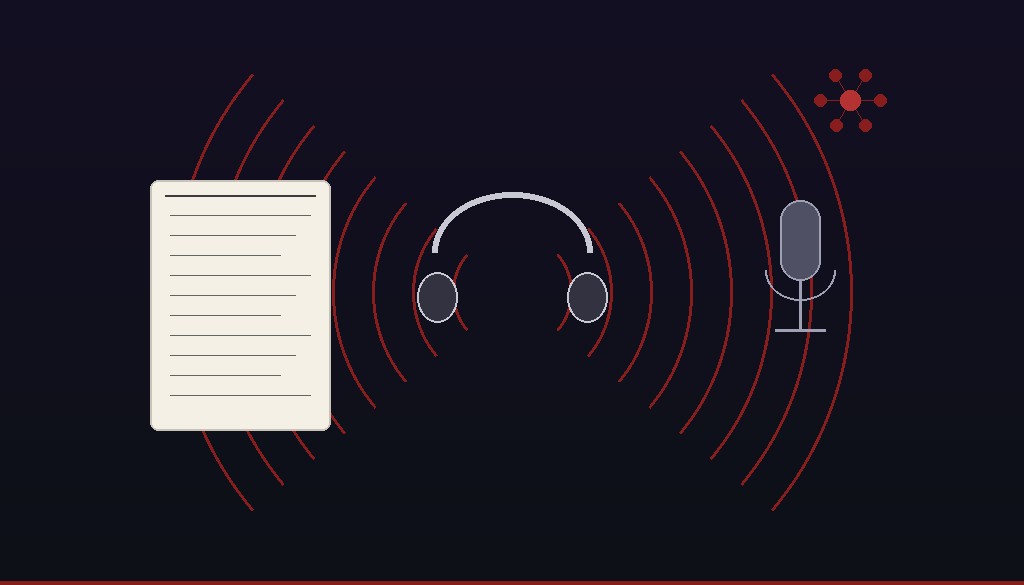
The breakthrough came with neural speech synthesis models. Trained on millions of hours of human speech, these models learned to reproduce natural intonation, dramatic pauses, variations in pace and even emotional nuance. The result is voices that in many contexts are practically indistinguishable from human narration. The technology used by Volyo Audiobooks shows that the quality already meets professional publishing expectations.
Beyond sounding natural, today's neural voices offer consistency. A human narrator's tone can vary between recording sessions, their voice can go hoarse, and extensive editing may be needed in post-production. A neural synthetic voice holds the same standard from beginning to end, however long the work.
Accessibility as the driver of change
For people who are blind, who have dyslexia, or whose motor limitations make handling physical books difficult, audiobooks are not a luxury or a convenience. They are a necessity, the primary route to knowledge, literature and formal education.
In Brazil, PNLD Digital and accessibility legislation, including the Brazilian Inclusion Act (Law 13.146/2015), require educational content to be accessible. That requirement is fair and necessary, but it is an enormous operational challenge for publishers whose catalogues hold hundreds or thousands of titles with no audio version.
This is exactly where neural speech synthesis becomes transformative. Producing audiobooks with AI makes meeting those requirements viable at scale. A publisher that would have taken years and spent millions to narrate its whole catalogue can now make that transition in months, at a fraction of the investment.
Concrete benefits for publishers
Adopting AI-narrated audiobooks brings tangible advantages to the publishing business. Production costs are significantly lower than professional human narration. An audiobook that would cost tens of thousands to record in a studio can be produced for a fraction of that with a neural voice, without the listener perceiving any loss of quality.
Production speed matters too. Where traditional recording involves booking studio time, narration sessions, review and post-production that can take weeks, AI production can be finished in days. That lets publishers release the audio version at the same time as the printed or digital book.
Another important point is the range of voices and languages available. Neural synthesis platforms offer dozens of voices in different languages and accents, so the publisher can pick the one that suits each kind of content. And when the original text is updated, as often happens with technical and educational works, the audio version can be regenerated easily, with no need to record again.
Being able to offer an audio version of the entire catalogue, including niche titles that would never justify human narration, widens the publisher's reach and creates new revenue from assets it already owns.
When to use AI and when to choose a human narrator
Neural speech synthesis does not fully replace human narration, and that is not the point of it. Each approach has its strengths, and the market is heading towards a hybrid model in which the two complement each other.
AI suits technical, legal, academic and educational works, where clarity and accuracy matter more than dramatic interpretation. Manuals, textbooks, reference works and corporate publications benefit enormously from AI production, both for the consistent quality and for the economics.
For literary fiction, first-person memoir and children's books, human narration still has the advantage in dramatic interpretation, characterisation and emotional connection with the listener. In those cases the investment in a professional narrator remains justified and advisable.
For most publishers the sensible decision is to use AI to make the broad catalogue possible and reserve human narration for the titles where it makes a strategic difference.
Volyo Audiobooks: Booknando's answer
Booknando built Volyo Audiobooks as a direct answer to the needs of publishers who want to enter the audiobook market efficiently and with quality under control. Volyo uses the latest neural voice technology to produce audiobooks that sound natural, accurate and consistent.
The process fits into the publisher's digital production flow. Starting from the proofread text, Volyo generates the audio in the chosen voice, runs it through quality control covering pronunciation, pace and intonation, and delivers the final file ready for distribution on the main audiobook platforms.
For publishers who need to meet PNLD accessibility requirements, or who want to widen their audio catalogue without straining the budget, Volyo Audiobooks offers a workable, scalable and professional route.
Conclusion
AI audiobook production is not a passing trend. It is a structural change in publishing that is already under way. Publishers who adopt the technology strategically will widen their reach, meet accessibility requirements and create new revenue from catalogues that until now existed only in print or in digital without audio.
Now is the moment to weigh this up. The technology is mature, the costs are within reach, and demand for audio content keeps growing. If your publishing house wants to explore what AI-narrated audiobooks can do, Booknando can help.